|
 |
 |
 |
 |
 |
 |
 |
 |
 |
 |
 |
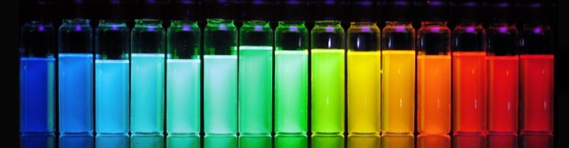
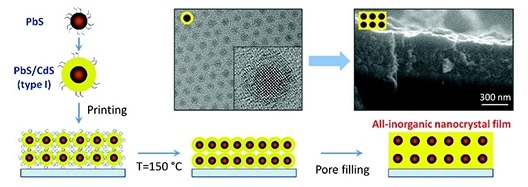
Materials ScienceDr. Mikhail Zamkov's research focuses on the electronic, chemical and optical properties of hybrid nanoscale materials prepared with sub-nanometer precision by means of colloidal syntheses. Such semiconductor or metal nanoparticles can be chemically manipulated like large molecules and can be coupled to each other or can be incorporated into different types of inorganic or organic matrices. The ease of manipulating both the dimensions of the individual particles as well as their arrangement in a complex interacting structure makes colloidal nanostructures well-suited for studies of size/structure-dependent quantum-mechanical interactions and as ideal building blocks for nanoscale engineering.
Specifically, experimental work in Dr. Zamkov's group addresses four major areas: (1) synthesis and characterization of novel nanoscale building blocks, (2) elucidation of their fundamental optoelectronic properties, (3) design and demonstration of functional nanoscale devices and integrated nanosystems, and (4) exploration of the interface/communication between biological systems and nanoscale devices. This research by is highly interdisciplinary, involving concepts and techniques from biology, chemistry, physics and the engineering sciences to achieve their goals.
Dr. Liangfeng Sun's research group fosters interdisciplinary research including diverse topics of physics, chemistry and engineering of nanostructured materials. The goal of his research team is to discover and investigate the novel physical and chemical properties of the materials in the nanometer scale, and apply them in photochemistry, bio-imaging, light-emitting devices and solar cells.
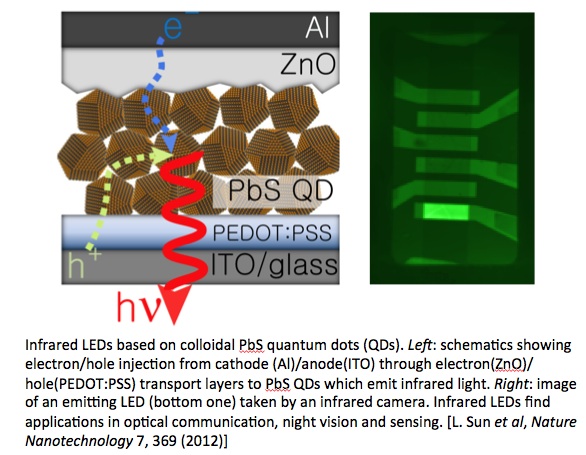
Dr. Sun's publications include one paper in Nature Nanotechnology, one paper in Physical Review Letters, and six papers in Nano Letters. His PbSe-nanocrystal-based solar cells rank among the highest performing nanocrystal-based solar cells reported to date. His record-brightness PbS-nanocrystal-based light-emitting diodes emit infrared light with tunable wavelength from 800 nm to 1800 nm, which will find broad application in free space and fiber optical communication, night vision and sensing.
The students in Dr. Sun's group learn and master many experimental techniques for nanomaterial research, including electron microscopy (such as TEM and SEM), UV-Vis-IR spectroscopy, laser technology, synthesis of nanostructured materials, optoelectronic device fabrication and testing. Moreover, they participate in planning future research and building up the lab, where they gain significant critical-thinking and problem-solving skills. These will be their assets when they pursue their future career either in academics or in industry. |
||||||
|
Home | General Information | People | Research | BGSU Planetarium | Academics | Links |
||||||