Astr 212: The Solar
System
Day 27: Venus -- Earth's "Evil
Twin"
1) What can we learn about Venus with
telescopes on Earth?
Orbit carries it close to Earth
•
- thick clouds, surface completely
obscured
Measure angular size:
- radar gives distance
- compute diameter = 0.95 x Earth's
(similar!)
No moons
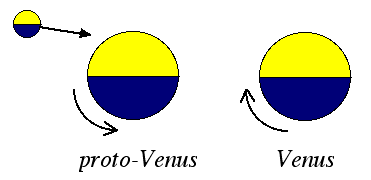
Radar enables measurement of "Venus day"
- time to complete one rotation on
axis
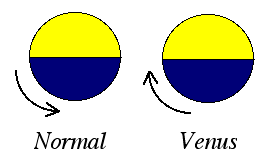
- why?
Spectra taken with telescopes show:
Much more CO2 than Earth:

- Venus's surface heats up, stays hot
(day& night)
2) How did we learn more about
Venus?
Visit! Unmanned space probes:
- USA (see website):
- Mariners 2, 5, & 10 (1962, 67,
74)
- Pioneer (1978)
- Magellan (1990-4)
- USSR: many!
Flyby and orbiting satellites:
- allow computation of Venus's
mass:
- from mass and radius, compute
density:
Drop probes into atmosphere (Ex. Pioneer):
- measure composition of atmosphere
gases:

- measure pressure of atmosphere
gases: •
- measure temperature:
- determine cloud layers:
- measure wind speeds:
3) In what ways is Venus similar to
Earth? Different?
Similarities:
- radius (volume, cooling
time)
- mass
- density
- has atmosphere
- orbit at similar distance from
Sun
- Earth's Twin...
Differences:
- rotating backwards very
slowly
- very thick & hot
atmosphere
4) Why does Venus have so much more
carbon dioxide?
When newly formed, Venus & Earth were probably similar:
- formed at similar region of solar
nebula
- similar proportions of iron, rocky
minerals,
volatiles
- had similar early
atmospheres:
- Earth farther from sun, less
heat
- Venus closer to sun, more
heat
5) What happened to the water Venus did
have?
Deuterium (heavy hydrogen: 1p, 1n) unusually abundant on Venus
- suggests there was once lots of
H2O
- hotter temps, so all water stays as
vapor high in atm
- Venus has no ozone layer to block out UV
rays
- most of water on Venus was
destroyed
Tonight's Reading:
- Sec. 22-1, starting at "Surface" (pp.
475-483)
Andy Layden, Fall 2004.